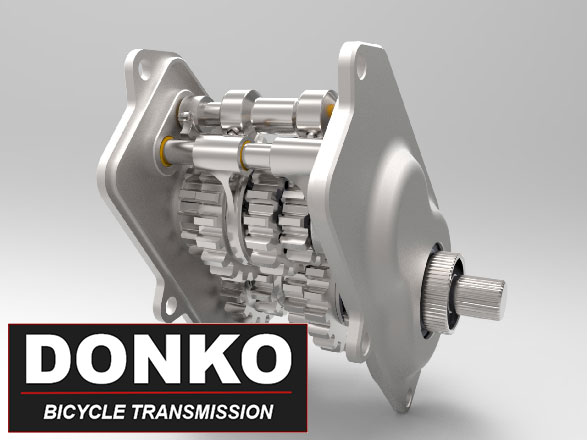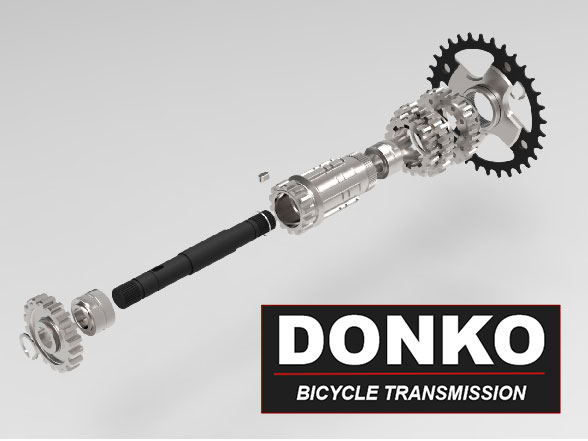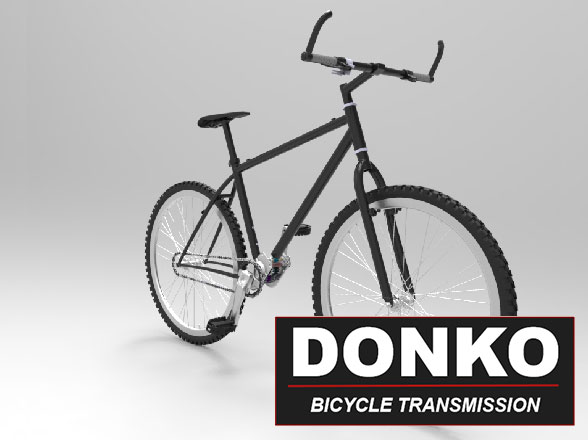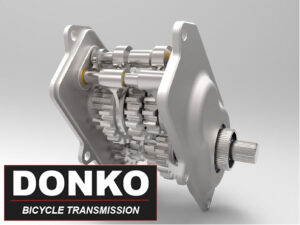
Brief description of the project: Donko bicycle step transmission.


Section

Details
Project NameStepped Mechanical Transmission for Pedal-Driven Vehicles.
Project Idea– Establishing production of the innovative bicycle transmission “Donko” for various types of pedal-driven vehicles.
– Manufacturing cargo bicycles in Ukraine for diverse purposes.
– Licensing production of bicycles equipped with the “Donko” transmission in other countries.
Project SummaryThe bicycle market requires reliable transmissions capable of withstanding significant loads while remaining easy to maintain and repair.

“Donko” equipped bicycles (city, touring, and cargo types) create new opportunities for cyclists. Their durability enables new segments, such as three-wheeled cargo bicycles and pedicabs. The “Donko” transmission combines the simplicity of a standard coaster brake bicycle hub with a wide torque transformation range.
Potential MarketMain markets include Southeast Asia, estimated at ~3 million units/year with monetization of $30–150 million annually.
Advantages– Instant gear shifting and braking by pedaling backward, similar to a regular bike.
– Hermetically sealed and integrated into the bicycle frame for durability.
– Long-lasting and low-maintenance design.
– Simple manufacturing process enabling competitive pricing.
– Enhanced accessibility for women, the elderly, and individuals with minor physical limitations.
Project Stage– Prototype developed and successfully tested.
– Protected by Ukrainian Patent No. 101889.
– Market entry concept prepared.
Investment Needs– Up to $60,000 for creating a production model and adapting technical documentation.
– $500,000+ for global market entry, depending on strategy and business model.
Payback Period1.5–3 years, depending on investment scale and market strategy.
Additional InformationThe emergence of bicycles like the Pinion P1.18, which integrates similar stepped transmissions, highlights global demand for
such technology. However, the “Donko” transmission addresses specific shortcomings of existing models, offering superior performance.


Competitive Advantages of the Innovative Bicycle Transmission “Donko”

The “Donko” bicycle transmission brings unique opportunities to amateur cyclists, especially for road, urban, touring, and two- or three-wheeled bicycles. These types of bicycles represent the largest segment of the global bicycle market. The combination of improved handling comfort and affordability positions “Donko” as an attractive option for new categories of cyclists, including women, the elderly, and individuals with minor physical limitations who previously could not enjoy cycling.

Moreover, the “Donko” transmission is expected to gain attention from current road bike owners seeking enhanced functionality without learning new skills. It also appeals to users who find traditional single-speed bicycles insufficient but are not interested in complex multi-speed sports bikes.

The robust construction of the “Donko” transmission opens opportunities for new market segments such as three-wheeled cargo bikes and pedicabs. Its capability to handle high loads makes it ideal for such applications.


Key Features and Advantages

  1. Wide Torque Transformation Range
    The “Donko” transmission offers a torque transformation range exceeding 500%, combining the reliability of traditional road bikes with advanced mechanical efficiency.

  2. Ease of Use

    • Instant gear shifting and braking by backpedaling, similar to traditional coaster-brake bicycles.
    • This reflexive and intuitive braking mechanism is especially convenient for many cyclists, particularly women and casual riders.
  3. Durable and Reliable Design

    • Encased in a sturdy, sealed housing integrated into the bicycle frame, the transmission is protected from external damage and environmental factors.
    • Ensures years of maintenance-free operation, unlike sports bicycles that require frequent servicing.
  4. Technological Simplicity

    • Simple to manufacture, allowing for mass production at competitive prices.
  5. Adaptability for New Markets

    • Enables the creation of touring four-wheeled velomobiles with lightweight canopies or polymeric bodies.


Design diagram of the Pinion P1.18 transmission:
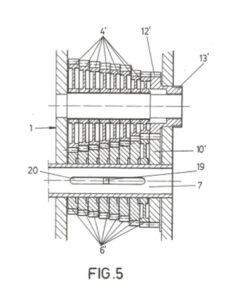
Photo Design Diagram of the Pinion P1.18 transmission

Design diagram of the “Donko” transmission:
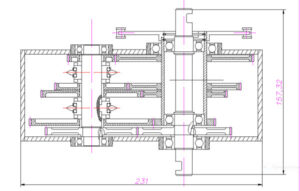
Photo Design diagram of the "Donko" transmission

Comparison with Competing Technologies

While planetary gear systems found in urban bicycles offer smooth rides, they are often expensive, complex, and unreliable under heavy loads. The Pinion P1.18, a competing step-based transmission, shares similarities with “Donko” but has several limitations:

  • Structural complexity increases the system’s weight and cost.
  • A high number of gears (9–12) reduces the gear size, limiting torque transformation range.
  • Transmission relies on a single movable pin within a tubular shaft, raising concerns about its ability to handle heavy loads, particularly in cargo applications.

In contrast, “Donko” avoids these pitfalls while delivering unmatched performance for its segment of the bicycle market.


Conclusion

The “Donko” transmission fills a critical gap in the market, offering simplicity, durability, and affordability while catering to a wide range of users. Its innovative design positions it as a leading solution for creating new bicycle categories and expanding the cycling community.

Below are the schematic diagrams of two closest competing step-based mechanical transmissions, highlighting their differences and the superiority of “Donko.”

Response Regarding Pinion Technology

Thank you so much for your question! I learned about this design over a year ago but was unaware it had already been brought to life. Thanks to you, I’ve now seen it in action. Interestingly, a WIPO specialist conducting an international examination of my patent in the Netherlands recommended using this Spanish patent as a prototype for my project.

Now to address the essence of the question: when I considered kinematic scheme options, Pinion was among them. Thankfully, I chose a different approach. On one hand, this ensured patent uniqueness, and on the other, it enabled a completely different design concept to be realized.


Key Differences Between Donko and Pinion P1.18

Despite similarities, such as the alignment of the input and output shafts, Donko and Pinion P1.18 have two fundamental differences:

1. Output Shaft Design

In Pinion, the short output shaft is supported by a single dual-row bearing on the gearbox casing wall. Opposing bending moments from the gears and rear-wheel drive chain necessitate a robust hub in the gearbox casing, which adds weight and complexity to the transmission.

In contrast, Donko employs a tubular output shaft supported internally by two spaced bearings on the primary shaft. This creates a unified, rigid structure supported on both sides of the casing, significantly increasing resistance to bending moments. The additional weight of the tubular shaft is offset by proportionally reduced gear radii.


2. Gear Shifting Mechanism

Pinion uses a complex internal mechanism housed within the intermediate shaft. While its durability remains to be proven over time, it’s clear that it is more expensive compared to the simpler gear-shifting clutches used in Donko.

  • Pinion’s internal design was necessary to save space for seven gear rows, combined with a planetary step-up reducer to provide up to 14 speeds.
  • Donko offers four gears with over 500% torque transformation. It is simpler, more reliable, and significantly more cost-effective.

Practical Implications

Donko’s design was developed for road, urban, and cargo bicycles, which account for over 60% of all bicycles sold. These segments prioritize reliability and affordability over the high number of gears required for competitive sports cycling.

While more gears are preferable for sports bikes where maintaining a specific cadence is crucial, Donko’s four gears are sufficient for comfortable riding in its target markets. Cyclists in these segments are often content to ride at a slightly slower pace if it means a more reliable and cost-effective bicycle.


Final Thoughts

Thank you again for your question! It was incredibly insightful. I would also be curious to know the price of bicycles equipped with Pinion technology.